A Longitudinal Study of Oral Health-Related Quality of Life Following Complete Denture Treatment Using a Suction-Effective Mandibular Impression Technique
1)The Academy of Clinical Dentistry
2)Jimbu Dental Clinic
3)Department of Periodontology, School of Life Dentistry at Tokyo, The Nippon Dental University
Abstract
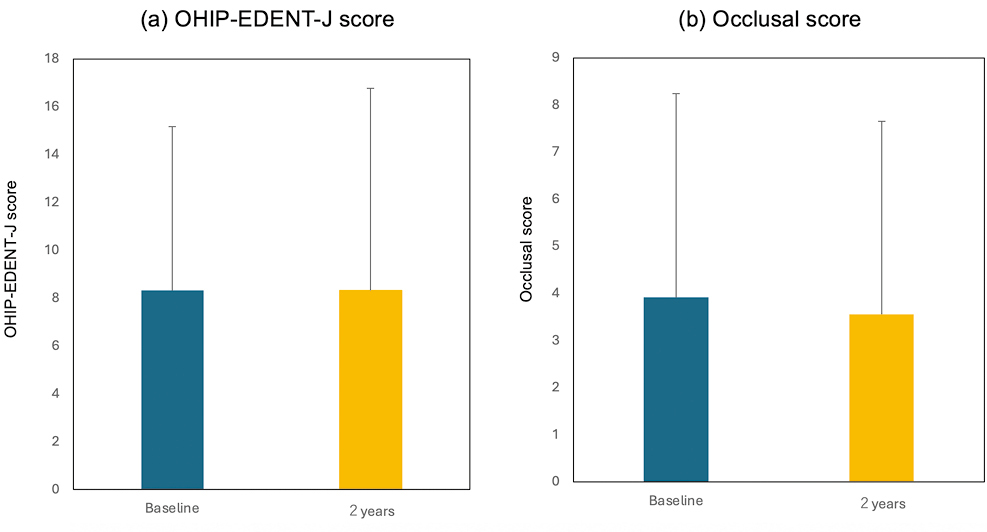
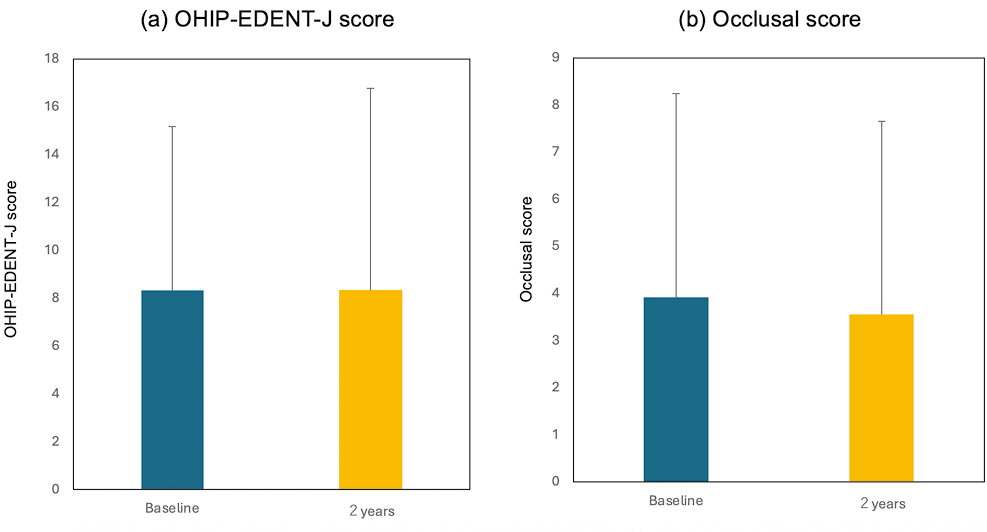
This study aimed to investigate longitudinal changes in oral health-related quality of life (OHRQoL) over a two-year period and to identify factors associated with its maintenance in patients wearing complete dentures fabricated using the mandibular complete denture suction effective impression technique. The study included 68 patients who received complete dentures fabricated with this technique between 2021 and 2022 and attended maintenance visits. The OHIP-EDENT-J and occlusal score were assessed at baseline and at two years. Twenty-five patients who completed the two-year follow-up were included in the analysis. The OHIP-EDENT-J score changed from 8.32 ± 6.86 at baseline to 8.32 ± 8.46 at two years, and the occlusal score changed from 3.92 ± 4.32 to 3.56 ± 4.10, with no statistically significant changes observed in either measure. However, stability/improvement in OHIP-EDENT-J was significantly associated with maxillary denture retention and stability and treatment by a certified dentist in clinical occlusion. No significant factors were identified for the stability of the occlusal score. These findings indicate that OHRQoL and occlusal status are well maintained over two years in complete denture patients treated with the mandibular suction effective impression technique. Furthermore, denture retention and stability, as well as treatment by a certified dentist in clinical occlusion, may be contributing factors to long-term OHRQoL maintenance.
Key words:OHIP-EDENT-J,Occlusion Score Complete denture, Oral-health related Quality of Life, Suction-Effective Mandibular Complete Denture
I. Introduction
Removable complete denture treatment for completely edentulous patients aims not only to restore masticatory and phonetic functions but also to improve oral health-related quality of life (OHRQoL). Tooth loss affects not only masticatory and aesthetic function but also has significant psychological and social consequences; therefore, patient-reported outcome measures (PROMs) have recently been established as important evaluation parameters. Previous studies have consistently reported that prosthodontic treatment with conventional complete dentures significantly improves OHRQoL.1-3 Longitudinal studies have demonstrated that OHRQoL significantly improves approximately three months after new denture insertion, and this effect is maintained for at least 12 months.1-3 Systematic reviews and meta-analyses have also confirmed significant improvements using assessment tools such as OHIP-EDENT, OHIP-14, OHIP-49, and GOHAI, demonstrating that complete denture treatment positively affects patients' daily living and oral function.4-7
On the other hand, insufficient denture retention and stability are major factors contributing to reduced patient satisfaction and QoL with conventional complete dentures, and many cases, particularly with mandibular complete dentures, present difficulties in achieving adequate retention. Therefore, improving retention through refinements in impression techniques and denture fabrication methods remains an important challenge.
The suction effective impression is a technique designed to achieve peripheral seal and suction during function, and is expected to enable the fabrication of complete dentures with high retention and stability. Recent reports have indicated that dentures fabricated with this technique demonstrate higher OHRQoL compared to conventional methods.8 However, these reports are cross-sectional studies, and it remains unclear whether the observed QoL improvements are maintained over the long term.
Therefore, this prospective study aimed to evaluate longitudinal changes in OHRQoL over a two-year period in patients wearing complete dentures fabricated using the suction effective impression technique. Additionally, factors associated with long-term OHRQoL maintenance were investigated.
II. Subjects and Methods
A total of 68 patients who received complete dentures fabricated using an impression technique designed for mandibular complete denture suction between 2021 and 2022 and who attended maintenance/adjustment visits were included in this study. Following an interview regarding patient background, OHIP-EDENT-J and occlusal score9 recordings were performed. The same recordings were repeated after two years.
Detailed procedures for the mandibular complete denture suction effective impression technique have been reported previously;8 therefore, a brief overview is provided here. For the preliminary impression, two types of alginate impression materials with different viscosities were used. A custom tray for functional impression was fabricated from the preliminary impression, designed to adequately include the retromolar pads, buccal shelves, and retromylohyoid fossae. For the first precision impression, a soft relining material adjusted to high viscosity was used, and functional impressions were obtained while patients performed five types of functional movements: "pursing the lips," "drawing the mouth corners backward," "licking the lips," "pushing the operator's finger with the tongue," and "swallowing." Border molding was performed using a heavy-body silicone impression material as needed, followed by a second precision impression using an injection-type silicone impression material for functional impressions to obtain the final impression.
Assessment Items
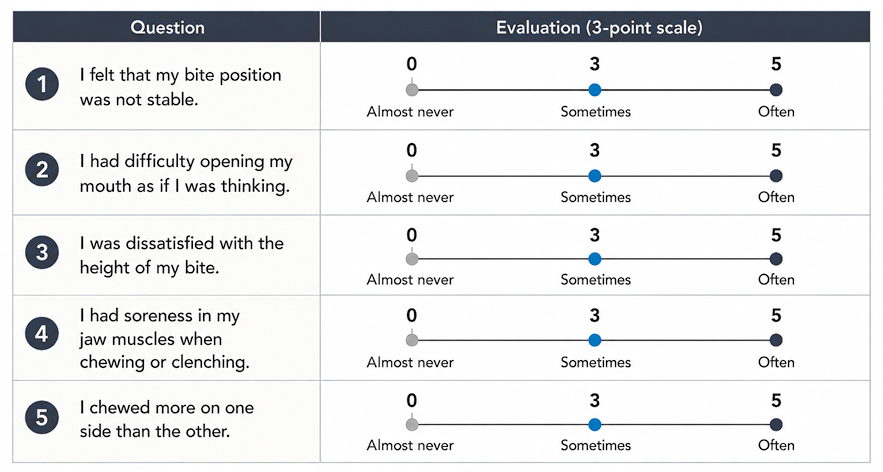
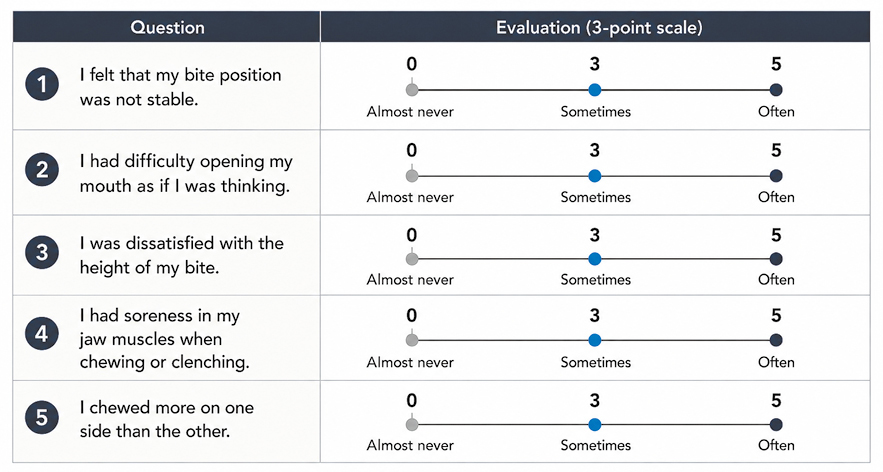
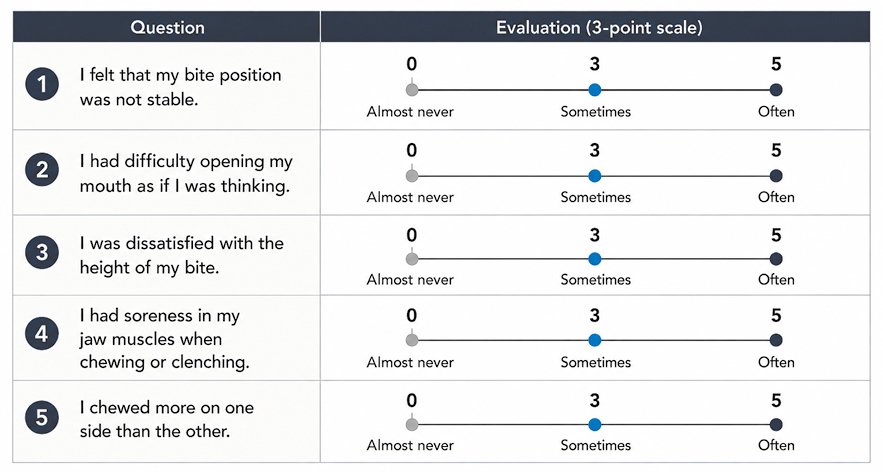
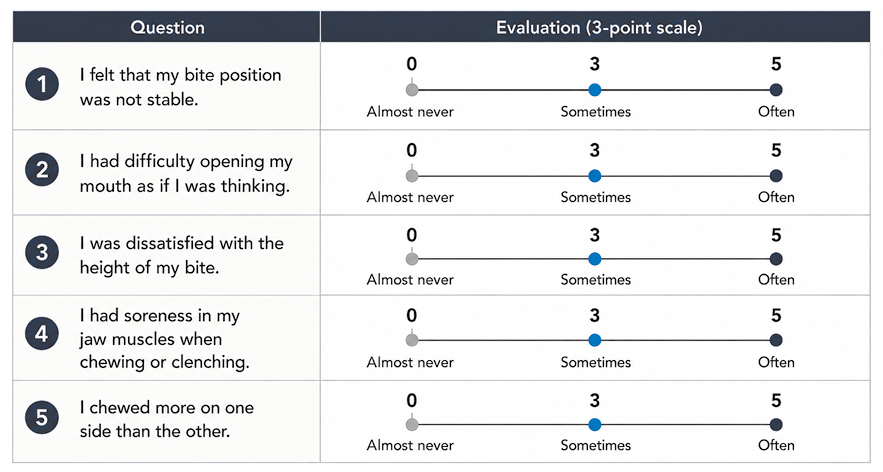
At baseline (BL) and at the two-year follow-up visit, patient-reported OHRQoL was recorded using the OHIP-EDENT-J as a subjective assessment. The OHIP-EDENT-J is a questionnaire-based assessment comprising 19 items rated on a 5-point scale (0–4). Higher scores indicate lower QoL and more problems. Occlusal status was also recorded using the occlusal score, a patient-reported outcome measure (Figure 1). The occlusal score is a self-check sheet developed by The Japanese Academy of Clinical Occlusion, in which patients circle applicable responses to occlusal score questions. Scores were calculated as: rarely = 0 points, slightly = 3 points, present = 5 points, with lower total scores indicating better occlusal status. For complete denture wearers, the item "Are you concerned about the alignment of your teeth?" was excluded because artificial tooth arrangement could be modified, and the survey was conducted using the remaining five items more directly related to occlusion. Scores ranged from a minimum of 0 to a maximum of 25. Furthermore, patients' intraoral conditions were examined, and information on subject characteristics (general and intraoral) and treatment details was collected from clinical records, and past treatment history was investigated.
Figure 1. Occlusion Score (Modified) Patients were asked about their experiences over the past month. Each question was rated on a 3-point scale (almost never = 0 points, sometimes = 3 points, often = 5 points). Total score range: 0–25 points (lower scores indicate better occlusal status).
Data Analysis
Changes in OHIP-EDENT-J scores and occlusal scores between baseline (BL) and two years were analyzed using paired t-tests. For comparisons of factors between the stable group and the worsened group for OHIP-EDENT-J scores and occlusal scores, respectively, unpaired t-tests were used for continuous variables and chi-square tests for categorical variables. The statistical significance level was set at 5% (p < 0.05).
III. Results
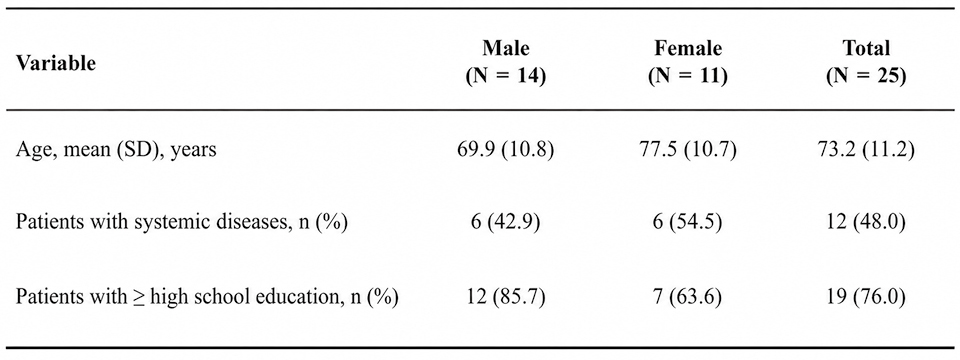
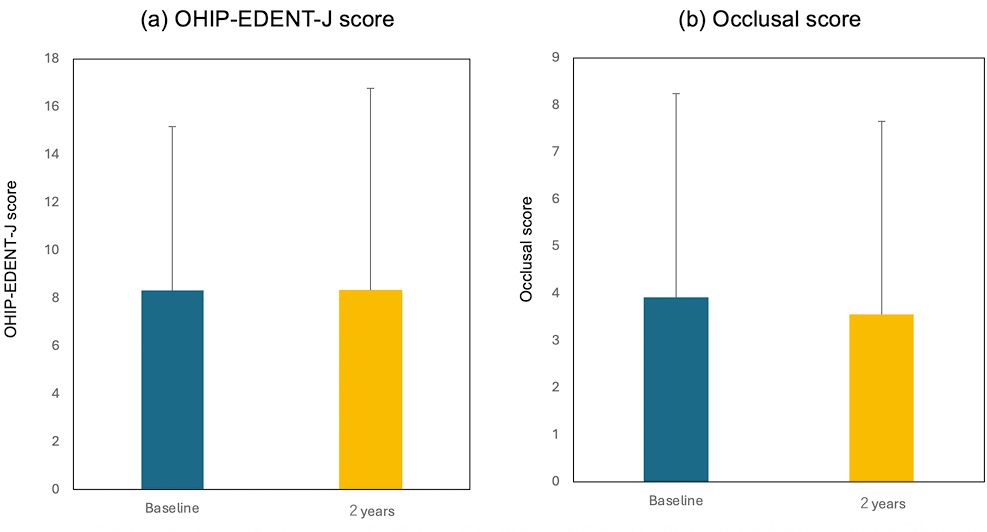
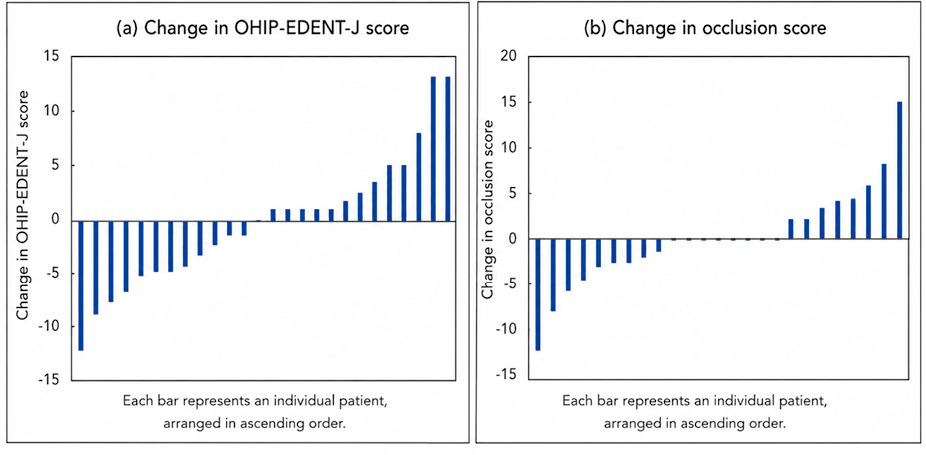
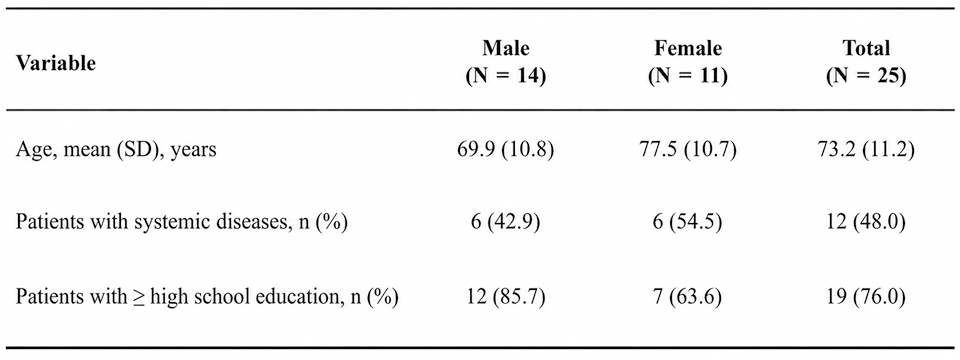
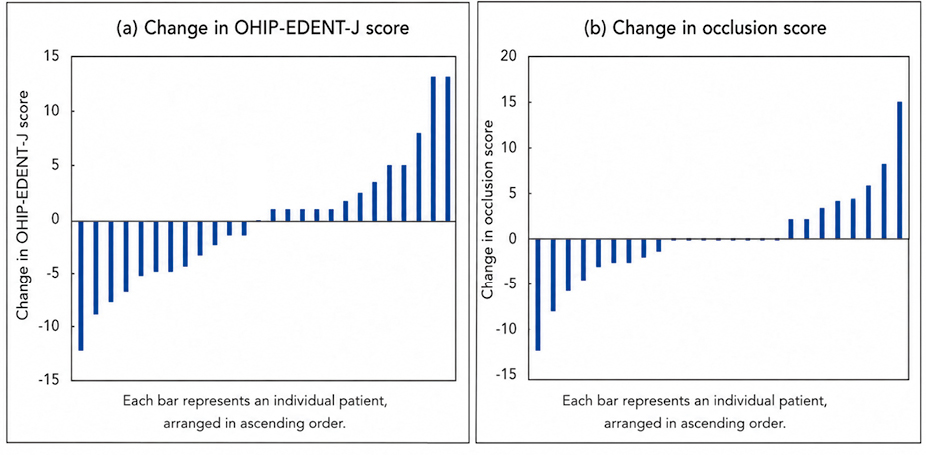
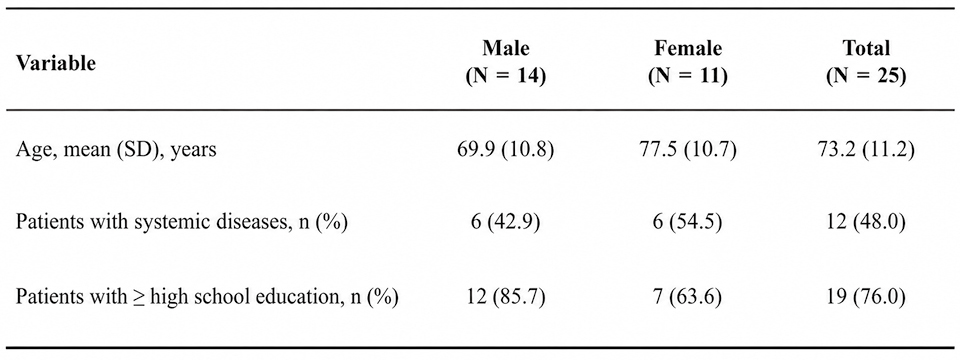
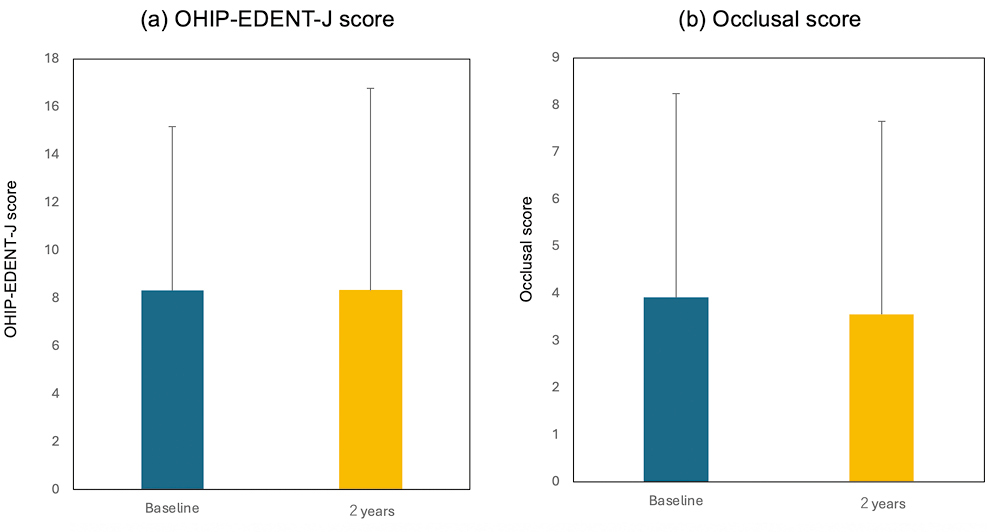
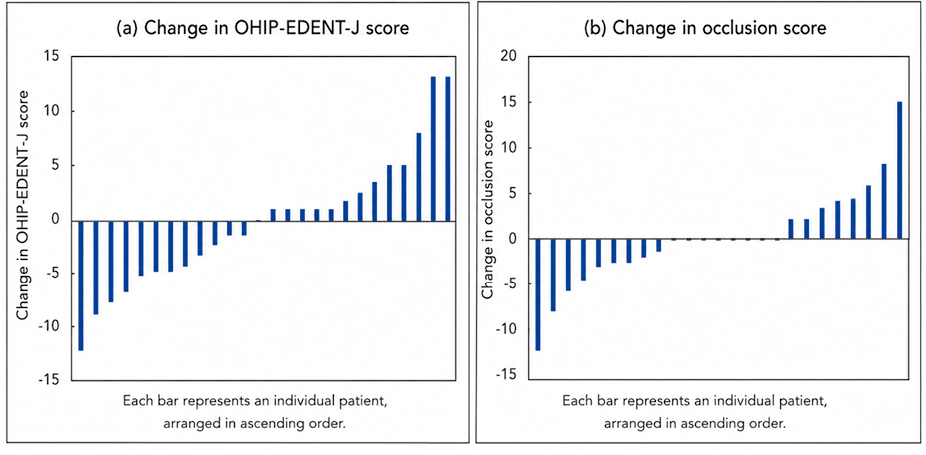
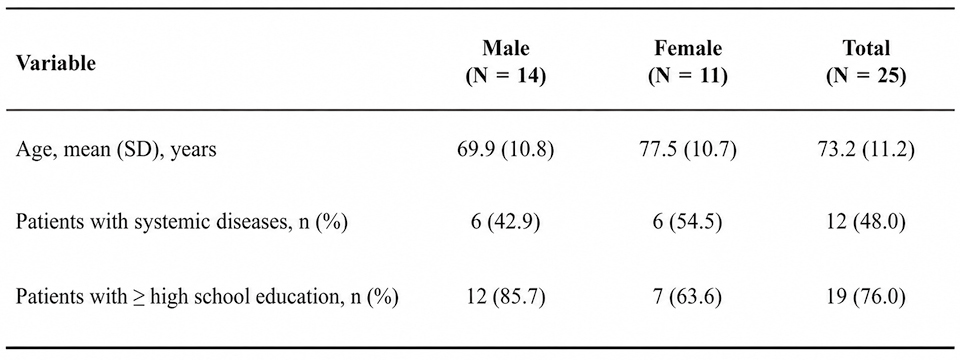
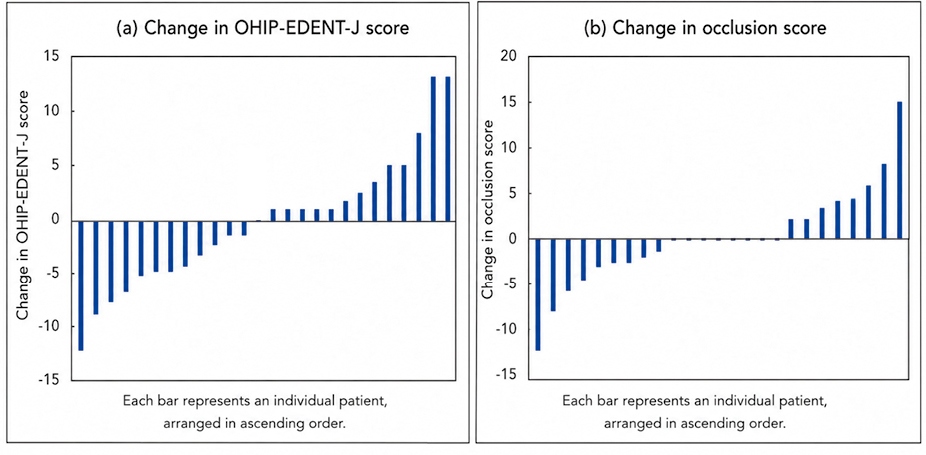
Twenty-five patients returned for the two-year follow-up. The mean age at baseline was 73.2 ± 11.2 years (Table 1). During this period, two patients received new dentures. No adverse events or complications were observed. The OHIP-EDENT-J score showed no significant change from 8.32 ± 6.86 at baseline to 8.32 ± 8.46 at two years (Figure 2a). Similarly, the occlusal score showed no statistically significant change from 3.92 ± 4.32 at baseline to 3.56 ± 4.10 at two years (Figure 2b). Individually, 11 patients showed deterioration in OHIP-EDENT-J over the two years (Figure 3a), and 8 patients showed deterioration in occlusal score (Figure 3b).
Table 1. Demographic characteristics of the participantsValues are presented as mean (SD) or number (%).Figure 2. Changes in the OHIP-EDENT-J score and occlusal score over 2 years. (a) OHIP-EDENT-J score; (b) Occlusal score. Note: Bars indicate mean values, and error bars indicate standard deviations (SD).Figure 3. Individual changes in OHIP-EDENT-J score (a) and occlusion score (b) over 2 years. Each bar represents the change in score for an individual patient, arranged in ascending order. The horizontal line (0) indicates no change from baseline. Negative values indicate deterioration in score, and positive values indicate improvement.
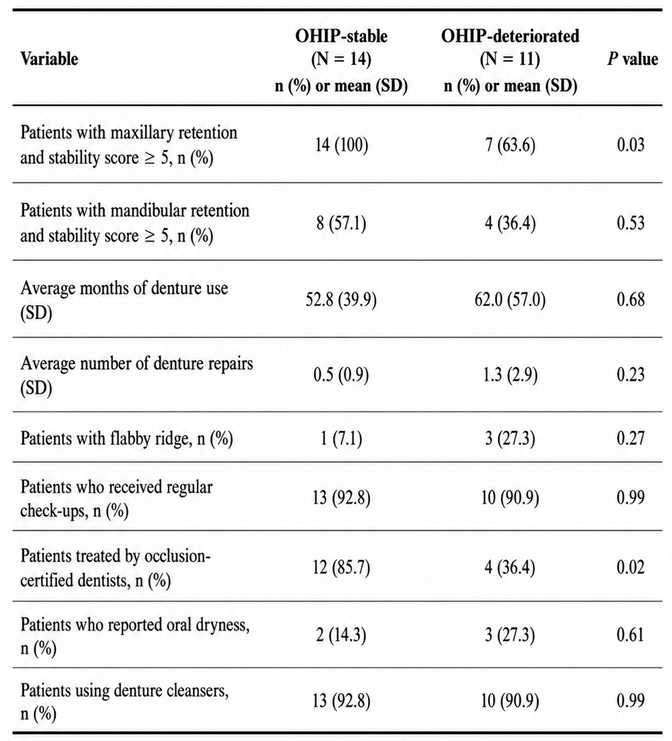
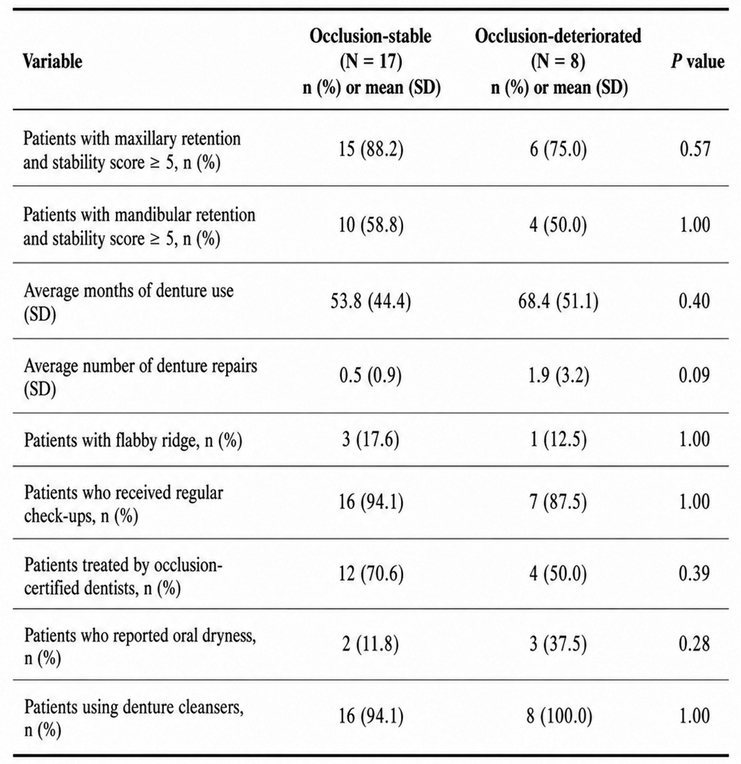
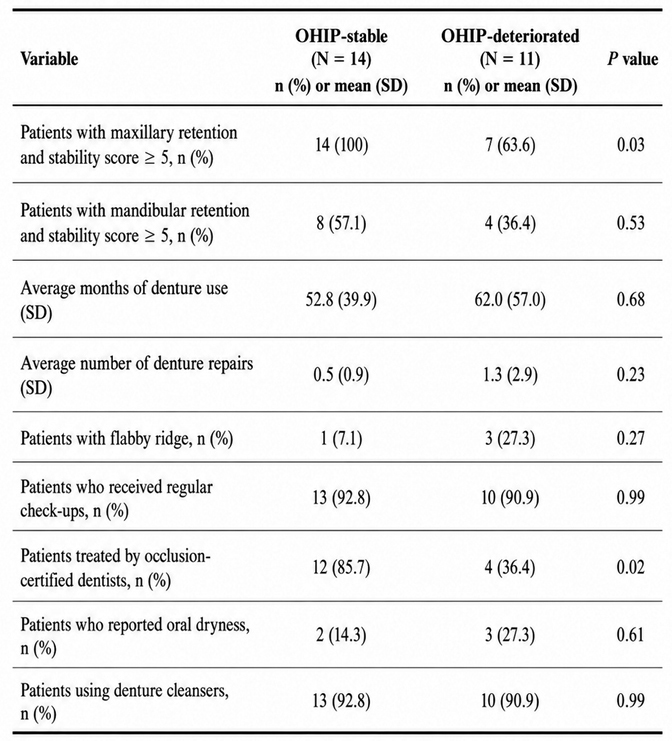
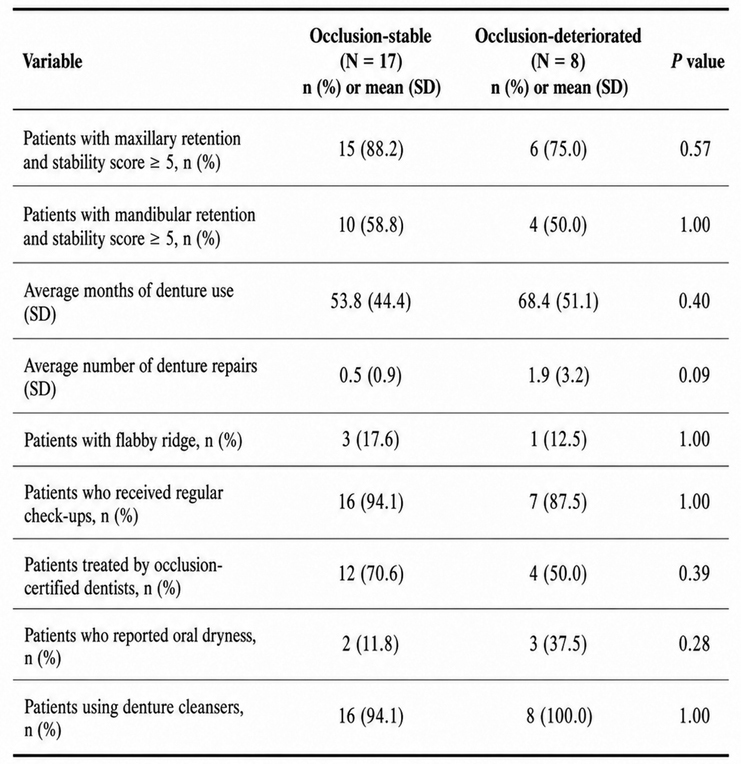
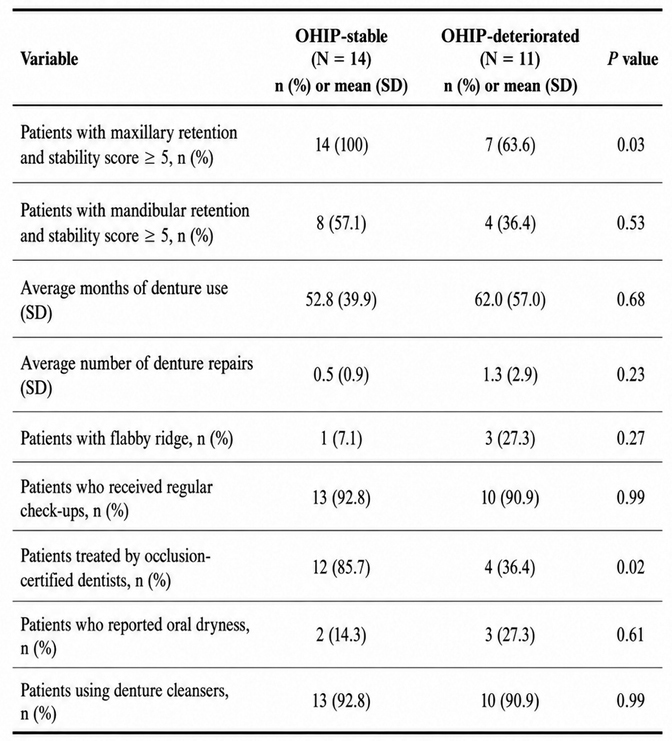
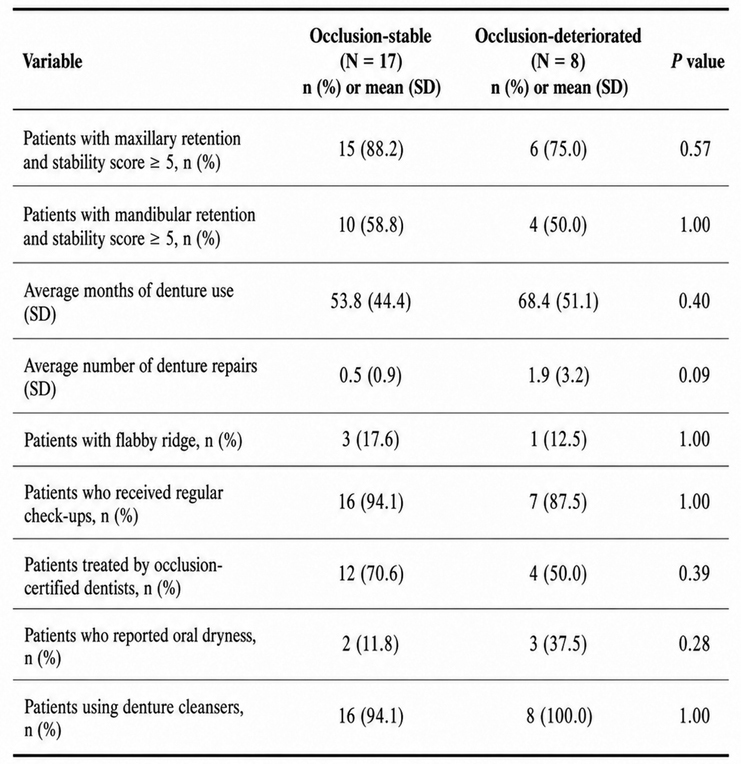
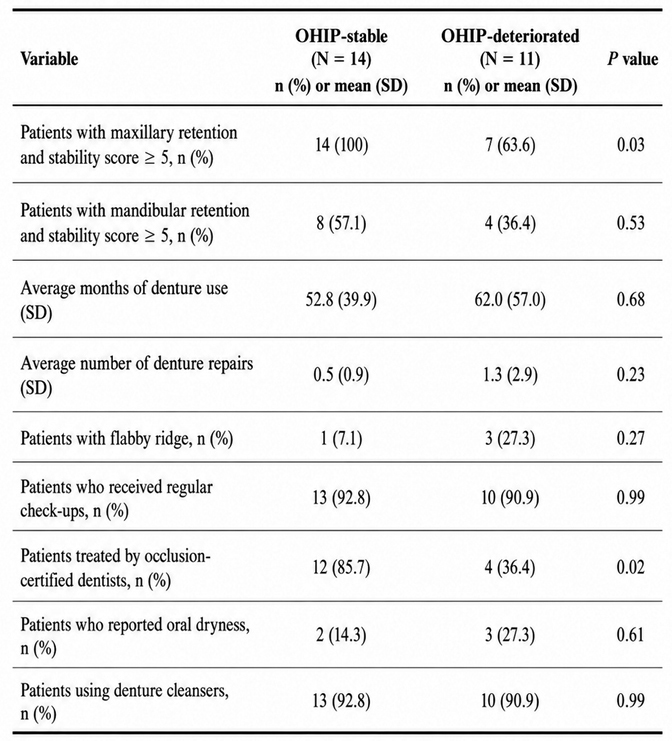
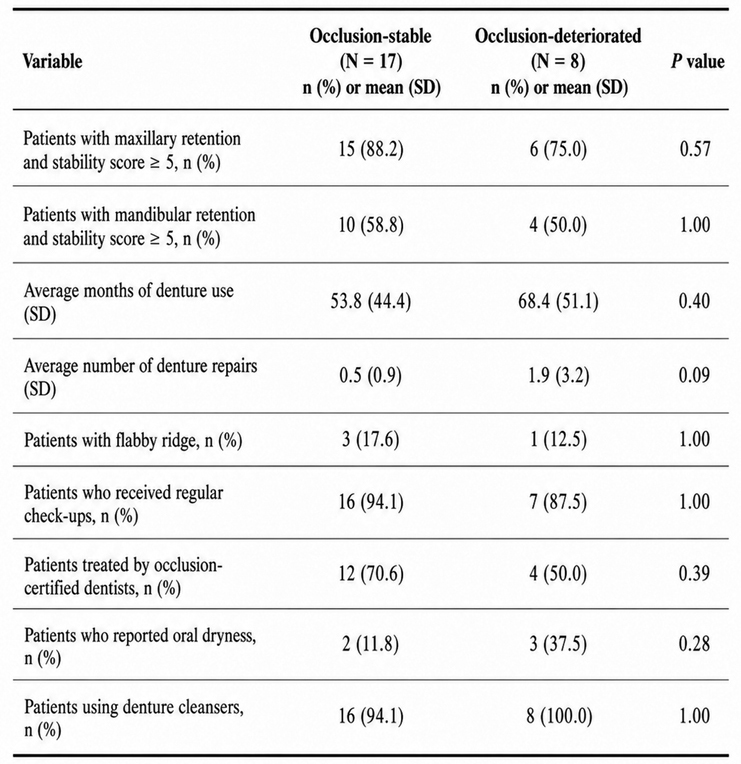
Factors influencing stabilization or improvement of OHIP-EDENT-J were maxillary denture retention/stability score and treatment by a certified dentist in clinical occlusion (Table 2). In contrast, for the occlusal score, no statistically significant differences were found between the stable and worsened groups for any of the examined items (Table 3).
Table 2. Factors associated with patients with stable or deteriorated OHIP-EDENT-J scores over 2 yearsValues are presented as number (%) or mean (SD). OHIP: Oral Health Impact Profile; EDENT-J: Japanese version for edentulous subjects.Table 3. Factors associated with patients with stable or deteriorated occlusion scores over 2 yearsValues are presented as number (%) or mean (SD). SD: standard deviation.
IV. Discussion
In this study, OHIP-EDENT-J and occlusal scores in patients wearing complete dentures fabricated with the mandibular suction effective impression technique remained stable without statistically significant changes over two years. The mean occlusal score changed from 3.92 ± 4.32 to 3.56 ± 4.10, maintaining the criterion of "no occlusal problems" (≤5 points) established by The Japanese Academy of Clinical Occlusion. Factors significantly associated with OHIP-EDENT-J stabilization were maxillary denture retention/stability score and treatment by a certified dentist in clinical occlusion. In the OHIP-EDENT-J stable group, all patients (100%) had a maxillary denture retention/stability score of 5 or higher, compared to only 63.6% in the worsened group, with a significant difference between groups (p = 0.03). For the occlusal score, 88.2% of the stable group and 75.0% of the worsened group had maxillary retention/stability scores of 5 or higher, but the difference was not significant (p = 0.57). Additionally, the proportion of patients who received treatment by a certified dentist in clinical occlusion was 85.7% in the OHIP-EDENT-J stable group versus 36.4% in the worsened group, showing a significant difference (p = 0.02). For the occlusal score, the proportions were 70.6% in the stable group and 50.0% in the worsened group, with no significant difference (p = 0.39). Considering the report by Kimoto et al.,10 which found significant differences in the number of adjustment visits for new complete dentures between junior clinicians and experienced clinicians, operator-related factors may have influenced treatment outcomes.
The proportion of patients with a mandibular retention/stability score of 5 or higher was somewhat higher in the occlusal score stable group (58.8%) than in the worsened group (50.0%), but the difference was not significant (p = 1.00), and the difference between groups was smaller than for the maxilla. This suggests that in cases with challenging anatomical conditions, achieving occlusal stability remains relatively difficult even with this impression technique.
A study by Kono et al.,11 which evaluated outcomes in 35 patients provided with new maxillary and mandibular complete dentures using masticatory function, patient satisfaction, and ridge status as parameters for technology assessment, also showed that at one month post-insertion, "maxillary denture fit" and "mandibular denture discomfort" were determining factors for patient satisfaction, which is generally consistent with the present findings.
As shown in the study by Fenlon et al.,12 establishing appropriate intermaxillary relationships is important for complete denture patient satisfaction. To achieve this, retention and stability of both maxillary and mandibular dentures are essential. However, it is readily inferable that deteriorating anatomical conditions of the maxillary and mandibular ridges may hinder the maintenance of good OHRQoL.
Furthermore, although OHRQoL stability was maintained over the two-year period in this study, this may have been partly attributable to regular maintenance by certified dentists in clinical occlusion, including appropriate management such as occlusal adjustment.
Study limitations include the small sample size (25 patients) due to a high dropout rate, which precluded multivariate analysis, and the relatively short two-year observation period. Future studies with larger sample sizes, longer-term follow-up, and comparative studies with conventional methods are warranted.
V. Conclusion
The following conclusions were drawn from this study:
・OHIP-EDENT-J and occlusal scores remained stable over the two-year period overall.
・Denture retention and stability, as well as treatment by a certified dentist in clinical occlusion, were considered to be associated with score stabilization and improvement.
References
Couto Martins AM, Campos CH, Salgueiro Frotté Silva C, et al.: Impact of New Complete Dentures on Oral Health-Related Quality of Life: A 12-Month Follow-Up. The International Journal of Prosthodontics, 35(3): 287-290, 2022
Sivakumar I, Sajjan S, Ramaraju AV, Rao B.: Changes in Oral Health-Related Quality of Life in Elderly Edentulous Patients After Complete Denture Therapy and Possible Role of Their Initial Expectation: A Follow-Up Study. Journal of Prosthodontics, 24(6): 452-456, 2015.
Aarabi G, John MT, Schierz O, Heydecke G, Reissmann DR.: The Course of Prosthodontic Patients' Oral Health-Related Quality of Life Over a Period of 2 Years.Journal of Dentistry, 43(2): 261-268, 2015.
Gennai S, Izzetti R, Pioli MC, Music L, Graziani F.: Impact of Rehabilitation Versus Edentulism on Systemic Health and Quality of Life in Patients Affected by Periodontitis: A Systematic Review and Meta-analysis. Journal of Clinical Periodontology, 49(S24): 328-358, 2022.
Linn TT, Khaohoen A, Thu KM, Rungsiyakull P.: Oral Health-Related Quality of Life in Elderly Edentulous Patients With Full-Arch Rehabilitation Treatments. Journal of Clinical Medicine, 13(12): 3391, 2024.
Rodrigues Meira Reis SC, de Paula JS, de Morais MAS, Ferreira RC, Gomes VE.: Impact of Treatment With Conventional Complete Dentures on (Oral) Health-Related Quality of Life: A Scoping Review. The International Journal of Prosthodontics, 32(3): 257-262, 2019.
de Medeiros AKB, Campos MFTP, da Silva Costa RSG, et al.: Improvement in Quality of Life of Elderly Edentulous Patients With New Complete Dentures: A Systematic Review. The International Journal of Prosthodontics, 32(3): 272-277, 2019.
Sato K, Hayashi H, Nagata K, Jimbu T, Adachi R, Azuma S, Nitobe Y, Kuroe T, Goto M, Sakamoto N, Sasahara M, Sato T, Sekino S.: Clinical Study on Factors Related to Oral Health-related Quality of Life of Patients with Complete Dentures: Multi-Center Study of an Impression Method in Pursuit of a Suction-Effective Mandibular Complete Denture. Journal of Interdisciplinary Clinical Dentistry, 4(1): e001, 2023.
Hosokawa R,Misumi S,Ueda H,Yamaji R,Kuratomi S,Hosoyama H,Nakashima T,Matsunobu M.Analytical results of prospective clinical study on Hobo occlusion score; our challenges for the future. J Acad Clin Dent,37(3): 200-205, 2017
Kimoto S, Kimoto K, Tanaka K et al. Effect of clinicians' experience on chair time and the number of denture adjustment visits required for complete denture treatment. Prosthodont Res Pract 2007; 6: 166-172.
Kono M, Sato Y, Kitagawa N, Shiina M, Hara S. Changes in Outcome evaluation before and after wearing new complete dentures. J. Jpn. Prosthodont. Soc 51: 260-269, 2007.
Fenlon MR, Sherriff M: An investigation of factors influencing patients` satisfaction with new complete dentures using structural equation modeling. J Dent, 36 (6) :427-434, 2008.
A Longitudinal Study of Oral Health-Related Quality of Life Following Complete Denture Treatment Using a Suction-Effective Mandibular Impression Technique
1)The Academy of Clinical Dentistry
2)Jimbu Dental Clinic
3)Department of Periodontology, School of Life Dentistry at Tokyo, The Nippon Dental University
Figure 1. Occlusion Score (Modified) Patients were asked about their experiences over the past month. Each question was rated on a 3-point scale (almost never = 0 points, sometimes = 3 points, often = 5 points). Total score range: 0–25 points (lower scores indicate better occlusal status).
Table 1. Demographic characteristics of the participantsValues are presented as mean (SD) or number (%).Figure 2. Changes in the OHIP-EDENT-J score and occlusal score over 2 years. (a) OHIP-EDENT-J score; (b) Occlusal score. Note: Bars indicate mean values, and error bars indicate standard deviations (SD).Figure 3. Individual changes in OHIP-EDENT-J score (a) and occlusion score (b) over 2 years. Each bar represents the change in score for an individual patient, arranged in ascending order. The horizontal line (0) indicates no change from baseline. Negative values indicate deterioration in score, and positive values indicate improvement.
Table 2. Factors associated with patients with stable or deteriorated OHIP-EDENT-J scores over 2 yearsValues are presented as number (%) or mean (SD). OHIP: Oral Health Impact Profile; EDENT-J: Japanese version for edentulous subjects.Table 3. Factors associated with patients with stable or deteriorated occlusion scores over 2 yearsValues are presented as number (%) or mean (SD). SD: standard deviation.
Couto Martins AM, Campos CH, Salgueiro Frotté Silva C, et al.: Impact of New Complete Dentures on Oral Health-Related Quality of Life: A 12-Month Follow-Up. The International Journal of Prosthodontics, 35(3): 287-290, 2022
Sivakumar I, Sajjan S, Ramaraju AV, Rao B.: Changes in Oral Health-Related Quality of Life in Elderly Edentulous Patients After Complete Denture Therapy and Possible Role of Their Initial Expectation: A Follow-Up Study. Journal of Prosthodontics, 24(6): 452-456, 2015.
Aarabi G, John MT, Schierz O, Heydecke G, Reissmann DR.: The Course of Prosthodontic Patients' Oral Health-Related Quality of Life Over a Period of 2 Years.Journal of Dentistry, 43(2): 261-268, 2015.
Gennai S, Izzetti R, Pioli MC, Music L, Graziani F.: Impact of Rehabilitation Versus Edentulism on Systemic Health and Quality of Life in Patients Affected by Periodontitis: A Systematic Review and Meta-analysis. Journal of Clinical Periodontology, 49(S24): 328-358, 2022.
Linn TT, Khaohoen A, Thu KM, Rungsiyakull P.: Oral Health-Related Quality of Life in Elderly Edentulous Patients With Full-Arch Rehabilitation Treatments. Journal of Clinical Medicine, 13(12): 3391, 2024.
Rodrigues Meira Reis SC, de Paula JS, de Morais MAS, Ferreira RC, Gomes VE.: Impact of Treatment With Conventional Complete Dentures on (Oral) Health-Related Quality of Life: A Scoping Review. The International Journal of Prosthodontics, 32(3): 257-262, 2019.
de Medeiros AKB, Campos MFTP, da Silva Costa RSG, et al.: Improvement in Quality of Life of Elderly Edentulous Patients With New Complete Dentures: A Systematic Review. The International Journal of Prosthodontics, 32(3): 272-277, 2019.
Sato K, Hayashi H, Nagata K, Jimbu T, Adachi R, Azuma S, Nitobe Y, Kuroe T, Goto M, Sakamoto N, Sasahara M, Sato T, Sekino S.: Clinical Study on Factors Related to Oral Health-related Quality of Life of Patients with Complete Dentures: Multi-Center Study of an Impression Method in Pursuit of a Suction-Effective Mandibular Complete Denture. Journal of Interdisciplinary Clinical Dentistry, 4(1): e001, 2023.
Hosokawa R,Misumi S,Ueda H,Yamaji R,Kuratomi S,Hosoyama H,Nakashima T,Matsunobu M.Analytical results of prospective clinical study on Hobo occlusion score; our challenges for the future. J Acad Clin Dent,37(3): 200-205, 2017
Kimoto S, Kimoto K, Tanaka K et al. Effect of clinicians' experience on chair time and the number of denture adjustment visits required for complete denture treatment. Prosthodont Res Pract 2007; 6: 166-172.
Kono M, Sato Y, Kitagawa N, Shiina M, Hara S. Changes in Outcome evaluation before and after wearing new complete dentures. J. Jpn. Prosthodont. Soc 51: 260-269, 2007.
Fenlon MR, Sherriff M: An investigation of factors influencing patients` satisfaction with new complete dentures using structural equation modeling. J Dent, 36 (6) :427-434, 2008.
A Longitudinal Study of Oral Health-Related Quality of Life Following Complete Denture Treatment Using a Suction-Effective Mandibular Impression Technique
1)The Academy of Clinical Dentistry
2)Jimbu Dental Clinic
3)Department of Periodontology, School of Life Dentistry at Tokyo, The Nippon Dental University
抄録
本研究は,下顎全部床義歯吸着印象法により製作した全部床義歯装着患者を対象に,口腔関連QOL(Oral Health-Related Quality of Life:OHRQoL)の2年間にわたる経時的変化と,その維持に関連する因子を検討することを目的とした.2021~2022年に同術式で製作した全部床義歯を装着し,メインテナンスのため来院した68名を対象とし,ベースラインおよび2年後にOHIP-EDENT-Jおよび咬合スコアを評価した.2年間の追跡が可能であった25名を解析対象とした結果,OHIPEDENT-Jはベースライン8.32±6.86,2年後8.32±8.46,咬合スコアは3.92±4.32から3.56±4.10へ推移し,いずれも統計学的に有意な変化は認められなかった.一方,OHIP-EDENT-Jの安定・改善には上顎義歯の維持安定性および咬み合わせ認定医による治療が有意に関連していた.他方,咬合スコアの安定に有意に関連する因子は認められなかった.以上より,下顎全部床義歯吸着印象法により製作した総義歯では,口腔関連QOLおよび咬合状態は2年間にわたり良好に維持されることが示された.また,義歯の維持・安定および咬み合わせ認定医による治療は,長期的な口腔関連QOLの維持に寄与する因子である可能性が示唆された.
Key words:OHIP-EDENT-J, Occlusion Score Complete denture, Oral-health related Quality of Life, Suction-Effective Mandibular
Complete Denture
Figure 1. Occlusion Score (Modified) Patients were asked about their experiences over the past month. Each question was rated on a 3-point scale (almost never = 0 points, sometimes = 3 points, often = 5 points). Total score range: 0–25 points (lower scores indicate better occlusal status).
Table 1. Demographic characteristics of the participantsValues are presented as mean (SD) or number (%).Figure 2. Changes in the OHIP-EDENT-J score and occlusal score over 2 years. (a) OHIP-EDENT-J score; (b) Occlusal score. Note: Bars indicate mean values, and error bars indicate standard deviations (SD).Figure 3. Individual changes in OHIP-EDENT-J score (a) and occlusion score (b) over 2 years. Each bar represents the change in score for an individual patient, arranged in ascending order. The horizontal line (0) indicates no change from baseline. Negative values indicate deterioration in score, and positive values indicate improvement.
Table 2. Factors associated with patients with stable or deteriorated OHIP-EDENT-J scores over 2 yearsValues are presented as number (%) or mean (SD). OHIP: Oral Health Impact Profile; EDENT-J: Japanese version for edentulous subjects.Table 3. Factors associated with patients with stable or deteriorated occlusion scores over 2 yearsValues are presented as number (%) or mean (SD). SD: standard deviation.
Couto Martins AM, Campos CH, Salgueiro Frotté Silva C, et al.: Impact of New Complete Dentures on Oral Health-Related Quality of Life: A 12-Month Follow-Up. The International Journal of Prosthodontics, 35(3): 287-290, 2022
Sivakumar I, Sajjan S, Ramaraju AV, Rao B.: Changes in Oral Health-Related Quality of Life in Elderly Edentulous Patients After Complete Denture Therapy and Possible Role of Their Initial Expectation: A Follow-Up Study. Journal of Prosthodontics, 24(6): 452-456, 2015.
Aarabi G, John MT, Schierz O, Heydecke G, Reissmann DR.: The Course of Prosthodontic Patients' Oral Health-Related Quality of Life Over a Period of 2 Years.Journal of Dentistry, 43(2): 261-268, 2015.
Gennai S, Izzetti R, Pioli MC, Music L, Graziani F.: Impact of Rehabilitation Versus Edentulism on Systemic Health and Quality of Life in Patients Affected by Periodontitis: A Systematic Review and Meta-analysis. Journal of Clinical Periodontology, 49(S24): 328-358, 2022.
Linn TT, Khaohoen A, Thu KM, Rungsiyakull P.: Oral Health-Related Quality of Life in Elderly Edentulous Patients With Full-Arch Rehabilitation Treatments. Journal of Clinical Medicine, 13(12): 3391, 2024.
Rodrigues Meira Reis SC, de Paula JS, de Morais MAS, Ferreira RC, Gomes VE.: Impact of Treatment With Conventional Complete Dentures on (Oral) Health-Related Quality of Life: A Scoping Review. The International Journal of Prosthodontics, 32(3): 257-262, 2019.
de Medeiros AKB, Campos MFTP, da Silva Costa RSG, et al.: Improvement in Quality of Life of Elderly Edentulous Patients With New Complete Dentures: A Systematic Review. The International Journal of Prosthodontics, 32(3): 272-277, 2019.
Sato K, Hayashi H, Nagata K, Jimbu T, Adachi R, Azuma S, Nitobe Y, Kuroe T, Goto M, Sakamoto N, Sasahara M, Sato T, Sekino S.: Clinical Study on Factors Related to Oral Health-related Quality of Life of Patients with Complete Dentures: Multi-Center Study of an Impression Method in Pursuit of a Suction-Effective Mandibular Complete Denture. Journal of Interdisciplinary Clinical Dentistry, 4(1): e001, 2023.
Hosokawa R,Misumi S,Ueda H,Yamaji R,Kuratomi S,Hosoyama H,Nakashima T,Matsunobu M.Analytical results of prospective clinical study on Hobo occlusion score; our challenges for the future. J Acad Clin Dent,37(3): 200-205, 2017
Kimoto S, Kimoto K, Tanaka K et al. Effect of clinicians' experience on chair time and the number of denture adjustment visits required for complete denture treatment. Prosthodont Res Pract 2007; 6: 166-172.
Kono M, Sato Y, Kitagawa N, Shiina M, Hara S. Changes in Outcome evaluation before and after wearing new complete dentures. J. Jpn. Prosthodont. Soc 51: 260-269, 2007.
Fenlon MR, Sherriff M: An investigation of factors influencing patients` satisfaction with new complete dentures using structural equation modeling. J Dent, 36 (6) :427-434, 2008.
Estudio longitudinal de la calidad de vida relacionada con la salud bucodental después del tratamiento con prótesis completas mediante una técnica de impresión mandibular con efecto de succión
1)The Academy of Clinical Dentistry
2)Jimbu Dental Clinic
3)Department of Periodontology, School of Life Dentistry at Tokyo, The Nippon Dental University
Resumen
El objetivo de este estudio fue investigar los cambios longitudinales en la calidad de vida relacionada con la salud oral (OHRQoL) durante un período de dos años, así como los factores asociados a su mantenimiento, en pacientes portadores de prótesis completas fabricadas mediante la técnica de impresión por succión efectiva para la prótesis completa mandibular. Se incluyeron 68 pacientes que recibieron prótesis completas elaboradas con esta técnica entre 2021 y 2022 y que acudieron a citas de mantenimiento. Se evaluaron el OHIP-EDENT-J y la puntuación oclusal al inicio y a los dos años. Se analizaron 25 pacientes que completaron el seguimiento de dos años. La puntuación OHIP-EDENT-J pasó de 8,32 ± 6,86 al inicio a 8,32 ± 8,46 a los dos años, y la puntuación oclusal de 3,92 ± 4,32 a 3,56 ± 4,10, sin que se observaran cambios estadísticamente significativos en ninguna de las dos mediciones. Sin embargo, la estabilidad/mejoría del OHIP-EDENT-J se asoció significativamente con la retención y estabilidad de la prótesis maxilar y con el tratamiento realizado por un odontólogo certificado en oclusión. No se identificaron factores significativos para la estabilidad de la puntuación oclusal. Estos hallazgos indican que la OHRQoL y el estado oclusal se mantienen adecuadamente durante dos años en pacientes con prótesis completas tratados con la técnica de impresión por succión efectiva mandibular. Además, la retención y estabilidad de la prótesis, así como el tratamiento por un odontólogo certificado en oclusión, pueden ser factores que contribuyan al mantenimiento a largo plazo de la OHRQoL.
Palabras clave:OHIP-EDENT-J,Occlusion Score Complete denture, Oral-health related Quality of Life, Suction-Effective Mandibular Complete Denture
I. Introducción
El tratamiento con prótesis completas removibles para pacientes completamente desdentados tiene como objetivo no solo restaurar la función masticatoria y fonética, sino también mejorar la calidad de vida relacionada con la salud oral (OHRQoL). La pérdida de dientes afecta no solo la masticación y la estética, sino que también tiene importantes consecuencias psicológicas y sociales; por ello, en los últimos años las medidas de resultados reportadas por el paciente (PROMs) se han establecido como parámetros de evaluación fundamentales. Estudios previos han informado consistentemente que el tratamiento protésico con prótesis completas convencionales mejora significativamente la OHRQoL.1-3 Los estudios longitudinales han demostrado que la OHRQoL mejora significativamente aproximadamente tres meses después de la inserción de una nueva prótesis, y que este efecto se mantiene durante al menos 12 meses.1-3 Las revisiones sistemáticas y metaanálisis también han confirmado mejoras significativas utilizando instrumentos como OHIP-EDENT, OHIP-14, OHIP-49 y GOHAI, lo que demuestra que el tratamiento con prótesis completas afecta positivamente la vida diaria y la función oral de los pacientes.4-7
Por otro lado, la retención y estabilidad insuficientes de las prótesis completas convencionales son factores principales que contribuyen a la reducción de la satisfacción del paciente y de la calidad de vida, y muchos casos, particularmente con prótesis completas mandibulares, presentan dificultades para lograr una retención adecuada. Por lo tanto, mejorar la retención mediante refinamientos en las técnicas de impresión y en los métodos de fabricación de prótesis sigue siendo un desafío importante.
La impresión por succión efectiva es una técnica diseñada para lograr el sellado periférico y la succión durante la función, y se espera que permita la fabricación de prótesis completas con alta retención y estabilidad. Informes recientes han indicado que las prótesis fabricadas con esta técnica demuestran una mayor OHRQoL en comparación con los métodos convencionales.8 Sin embargo, estos informes son estudios transversales, y no está claro si las mejoras observadas en la QoL se mantienen a largo plazo.
Por lo tanto, este estudio prospectivo tuvo como objetivo evaluar los cambios longitudinales en la OHRQoL durante un período de dos años en pacientes portadores de prótesis completas fabricadas con la técnica de impresión por succión efectiva. Además, se investigaron los factores asociados con el mantenimiento a largo plazo de la OHRQoL.
II. Sujetos y métodos
Se incluyeron en este estudio un total de 68 pacientes que recibieron prótesis completas fabricadas mediante una técnica de impresión diseñada para la succión de la prótesis completa mandibular entre 2021 y 2022, y que acudieron a citas de mantenimiento/ajuste. Tras una entrevista sobre los antecedentes del paciente, se registraron el OHIP-EDENT-J y la puntuación oclusal.9 Los mismos registros se repitieron a los dos años.
Técnica de impresión por succión efectiva para la prótesis completa mandibular
Los procedimientos detallados de la técnica de impresión por succión efectiva para la prótesis completa mandibular se han descrito previamente;8 por lo tanto, aquí se proporciona una breve visión general. Para la impresión preliminar se utilizaron dos tipos de materiales de impresión de alginato con diferentes viscosidades. A partir de la impresión preliminar se fabricó una cubeta individual para impresión funcional, diseñada para incluir adecuadamente las almohadillas retromolares, los rebordes bucales y las fosas retromilohioideas. Para la primera impresión de precisión se utilizó un material de rebasado blando ajustado a alta viscosidad, y se obtuvieron impresiones funcionales mientras los pacientes realizaban cinco tipos de movimientos funcionales: "fruncir los labios", "tirar de las comisuras hacia atrás", "lamer los labios", "empujar el dedo del operador con la lengua" y "tragar". Se realizó un modelado de bordes con un material de impresión de silicona de cuerpo pesado según fuera necesario, seguido de una segunda impresión de precisión utilizando un material de impresión de silicona tipo inyección para impresiones funcionales, obteniendo así la impresión final.
Elementos de evaluación
En la visita inicial (VI) y en la visita de seguimiento a los dos años, la OHRQoL reportada por el paciente se registró mediante el OHIP-EDENT-J como evaluación subjetiva. El OHIP-EDENT-J es un cuestionario que consta de 19 ítems valorados en una escala de 5 puntos (0-4). Las puntuaciones más altas indican una menor calidad de vida y más problemas. El estado oclusal también se registró mediante la puntuación oclusal, una medida de resultado reportada por el paciente (Figura 1). La puntuación oclusal es una hoja de autoevaluación desarrollada por la Academia Japonesa de Oclusión y Salud, en la que los pacientes marcan las respuestas aplicables a las preguntas sobre la puntuación oclusal. Las puntuaciones se calcularon como: casi nunca = 0 puntos, leve = 3 puntos, presente = 5 puntos; una puntuación total más baja indica una mejor oclusión. Para los portadores de prótesis completas, se eliminó el ítem "¿Le preocupa la alineación de sus dientes?" porque la disposición de los dientes artificiales puede modificarse, y la encuesta se realizó con los cinco ítems restantes más directamente relacionados con la oclusión. Las puntuaciones oscilaron entre un mínimo de 0 y un máximo de 25. Además, se examinaron las condiciones intraorales de los pacientes, y se recopiló información sobre las características de los sujetos (generales e intraorales) y los detalles del tratamiento a partir de las historias clínicas, y se investigaron los antecedentes de tratamiento previo.
Figure 1. Occlusion Score (Modified) Patients were asked about their experiences over the past month. Each question was rated on a 3-point scale (almost never = 0 points, sometimes = 3 points, often = 5 points). Total score range: 0–25 points (lower scores indicate better occlusal status).
Análisis de datos
Los cambios en las puntuaciones del OHIP-EDENT-J y en las puntuaciones oclusales entre el inicio (VI) y los dos años se analizaron mediante pruebas t pareadas. Para las comparaciones de factores entre el grupo estable y el grupo empeorado para las puntuaciones OHIP-EDENT-J y las puntuaciones oclusales, respectivamente, se utilizaron pruebas t no pareadas para las variables continuas y pruebas de chi-cuadrado para las variables categóricas. El nivel de significación estadística se fijó en el 5% (p < 0,05).
III. Resultados
Veinticinco pacientes regresaron para el seguimiento de dos años. La edad media al inicio fue de 73,2 ± 11,2 años (Tabla 1). Durante este período, dos pacientes recibieron prótesis nuevas. No se observaron eventos adversos ni complicaciones. La puntuación OHIP-EDENT-J no mostró cambios significativos, pasando de 8,32 ± 6,86 al inicio a 8,32 ± 8,46 a los dos años (Figura 2a). De manera similar, la puntuación oclusal no mostró cambios estadísticamente significativos, pasando de 3,92 ± 4,32 al inicio a 3,56 ± 4,10 a los dos años (Figura 2b). Individualmente, 11 pacientes mostraron deterioro en el OHIP-EDENT-J durante los dos años (Figura 3a), y 8 pacientes mostraron deterioro en la puntuación oclusal (Figura 3b).
Table 1. Demographic characteristics of the participantsValues are presented as mean (SD) or number (%).Figure 2. Changes in the OHIP-EDENT-J score and occlusal score over 2 years. (a) OHIP-EDENT-J score; (b) Occlusal score. Note: Bars indicate mean values, and error bars indicate standard deviations (SD).Figure 3. Individual changes in OHIP-EDENT-J score (a) and occlusion score (b) over 2 years. Each bar represents the change in score for an individual patient, arranged in ascending order. The horizontal line (0) indicates no change from baseline. Negative values indicate deterioration in score, and positive values indicate improvement.
Los factores que influyeron en la estabilización o mejora del OHIP-EDENT-J fueron la puntuación de retención/estabilidad de la prótesis maxilar y el tratamiento por un odontólogo certificado en oclusión (Tabla 2). En contraste, para la puntuación oclusal, no se encontraron diferencias estadísticamente significativas entre los grupos estable y empeorado para ninguno de los ítems examinados (Tabla 3).
Table 2. Factors associated with patients with stable or deteriorated OHIP-EDENT-J scores over 2 yearsValues are presented as number (%) or mean (SD). OHIP: Oral Health Impact Profile; EDENT-J: Japanese version for edentulous subjects.Table 3. Factors associated with patients with stable or deteriorated occlusion scores over 2 yearsValues are presented as number (%) or mean (SD). SD: standard deviation.
IV. Discusión
En este estudio, las puntuaciones OHIP-EDENT-J y oclusales en pacientes portadores de prótesis completas fabricadas con la técnica de impresión por succión efectiva mandibular se mantuvieron estables sin cambios estadísticamente significativos durante dos años. La puntuación oclusal media pasó de 3,92 ± 4,32 a 3,56 ± 4,10, manteniendo el criterio de la Academia Japonesa de Oclusión y Salud de "sin problemas oclusales" (≤5 puntos). Los factores significativamente asociados con la estabilización del OHIP-EDENT-J fueron la puntuación de retención/estabilidad de la prótesis maxilar y el tratamiento por un odontólogo certificado en oclusión. En el grupo estable del OHIP-EDENT-J, todos los pacientes (100%) tenían una puntuación de retención/estabilidad de la prótesis maxilar de 5 o superior, en comparación con solo el 63,6% en el grupo empeorado, con una diferencia significativa entre los grupos (p = 0,03). Para la puntuación oclusal, el 88,2% del grupo estable y el 75,0% del grupo empeorado tenían puntuaciones de retención/estabilidad maxilar de 5 o superiores, pero la diferencia no fue significativa (p = 0,57). Además, la proporción de pacientes que recibieron tratamiento por un odontólogo certificado en oclusión fue del 85,7% en el grupo estable del OHIP-EDENT-J frente al 36,4% en el grupo empeorado, mostrando una diferencia significativa (p = 0,02). Para la puntuación oclusal, las proporciones fueron del 70,6% en el grupo estable y del 50,0% en el empeorado, sin diferencia significativa (p = 0,39). Teniendo en cuenta el informe de Kimoto et al.,10 que encontró diferencias significativas en el número de visitas de ajuste para prótesis completas nuevas entre clínicos jóvenes y clínicos experimentados, los factores relacionados con el operador pueden haber influido en los resultados del tratamiento.
La proporción de pacientes con una puntuación de retención/estabilidad mandibular de 5 o superior fue algo mayor en el grupo estable de la puntuación oclusal (58,8%) que en el grupo empeorado (50,0%), pero la diferencia no fue significativa (p = 1,00), y la diferencia entre grupos fue menor que para el maxilar. Esto sugiere que en casos con condiciones anatómicas desafiantes, lograr la estabilidad oclusal sigue siendo relativamente difícil incluso con esta técnica de impresión.
Un estudio de Kono et al.,11 que examinó los resultados en 35 pacientes que recibieron prótesis completas maxilares y mandibulares nuevas utilizando la función masticatoria, la satisfacción y el estado del reborde como evaluaciones tecnológicas, también mostró que al mes de la inserción, el "ajuste de la prótesis maxilar" y la "incomodidad de la prótesis mandibular" eran factores determinantes para la satisfacción del paciente, lo que es generalmente consistente con los hallazgos actuales.
Como se muestra en el estudio de Fenlon et al.,12 establecer relaciones intermaxilares adecuadas es importante para la satisfacción del paciente con prótesis completas. Para lograrlo, la retención y estabilidad de las prótesis maxilar y mandibular son esenciales. Sin embargo, es fácil inferir que el deterioro de las condiciones anatómicas de los rebordes maxilares y mandibulares puede dificultar el mantenimiento de una buena OHRQoL.
Además, aunque la estabilidad de la OHRQoL se mantuvo durante el período de dos años en este estudio, esto puede haberse debido en parte al mantenimiento regular por parte de odontólogos certificados en oclusión, incluyendo un manejo adecuado como el ajuste oclusal.
Las limitaciones del estudio incluyen el pequeño tamaño de la muestra (25 pacientes) debido a una alta tasa de abandono, lo que impidió realizar análisis multivariantes, y el período de observación relativamente corto de dos años. Se necesitan estudios futuros con muestras más grandes, seguimientos a más largo plazo y estudios comparativos con métodos convencionales.
V. Conclusiones
A partir de este estudio se extrajeron las siguientes conclusiones:
・Las puntuaciones OHIP-EDENT-J y oclusales se mantuvieron estables en general durante el período de dos años.
・La retención y estabilidad de la prótesis, así como el tratamiento por un odontólogo certificado en oclusión, se consideraron asociados con la estabilización y mejora de las puntuaciones.
References
Couto Martins AM, Campos CH, Salgueiro Frotté Silva C, et al.: Impact of New Complete Dentures on Oral Health-Related Quality of Life: A 12-Month Follow-Up. The International Journal of Prosthodontics, 35(3): 287-290, 2022
Sivakumar I, Sajjan S, Ramaraju AV, Rao B.: Changes in Oral Health-Related Quality of Life in Elderly Edentulous Patients After Complete Denture Therapy and Possible Role of Their Initial Expectation: A Follow-Up Study. Journal of Prosthodontics, 24(6): 452-456, 2015.
Aarabi G, John MT, Schierz O, Heydecke G, Reissmann DR.: The Course of Prosthodontic Patients' Oral Health-Related Quality of Life Over a Period of 2 Years.Journal of Dentistry, 43(2): 261-268, 2015.
Gennai S, Izzetti R, Pioli MC, Music L, Graziani F.: Impact of Rehabilitation Versus Edentulism on Systemic Health and Quality of Life in Patients Affected by Periodontitis: A Systematic Review and Meta-analysis. Journal of Clinical Periodontology, 49(S24): 328-358, 2022.
Linn TT, Khaohoen A, Thu KM, Rungsiyakull P.: Oral Health-Related Quality of Life in Elderly Edentulous Patients With Full-Arch Rehabilitation Treatments. Journal of Clinical Medicine, 13(12): 3391, 2024.
Rodrigues Meira Reis SC, de Paula JS, de Morais MAS, Ferreira RC, Gomes VE.: Impact of Treatment With Conventional Complete Dentures on (Oral) Health-Related Quality of Life: A Scoping Review. The International Journal of Prosthodontics, 32(3): 257-262, 2019.
de Medeiros AKB, Campos MFTP, da Silva Costa RSG, et al.: Improvement in Quality of Life of Elderly Edentulous Patients With New Complete Dentures: A Systematic Review. The International Journal of Prosthodontics, 32(3): 272-277, 2019.
Sato K, Hayashi H, Nagata K, Jimbu T, Adachi R, Azuma S, Nitobe Y, Kuroe T, Goto M, Sakamoto N, Sasahara M, Sato T, Sekino S.: Clinical Study on Factors Related to Oral Health-related Quality of Life of Patients with Complete Dentures: Multi-Center Study of an Impression Method in Pursuit of a Suction-Effective Mandibular Complete Denture. Journal of Interdisciplinary Clinical Dentistry, 4(1): e001, 2023.
Hosokawa R,Misumi S,Ueda H,Yamaji R,Kuratomi S,Hosoyama H,Nakashima T,Matsunobu M.Analytical results of prospective clinical study on Hobo occlusion score; our challenges for the future. J Acad Clin Dent,37(3): 200-205, 2017
Kimoto S, Kimoto K, Tanaka K et al. Effect of clinicians' experience on chair time and the number of denture adjustment visits required for complete denture treatment. Prosthodont Res Pract 2007; 6: 166-172.
Kono M, Sato Y, Kitagawa N, Shiina M, Hara S. Changes in Outcome evaluation before and after wearing new complete dentures. J. Jpn. Prosthodont. Soc 51: 260-269, 2007.
Fenlon MR, Sherriff M: An investigation of factors influencing patients` satisfaction with new complete dentures using structural equation modeling. J Dent, 36 (6) :427-434, 2008.